Pattern drift
AI invents new patterns every prompt. By feature 10 you have five error-handling approaches, three ways to fetch data, and zero consistency.
Vibe coding a SaaS is the fastest way to ship, but without the right foundation, AI-generated code breaks at scale. VibeReady is the production starter kit that makes vibe coding actually work: AI framework, quality gates, and structured workflows built in.
One-time purchase · unlimited projects
new-feature skill scopes the work, loads the right rules and patterns, and returns a reviewed plan before writing a line of code.
The methodology
Coined by Andrej Karpathy in February 2025, vibe coding is a new way to build software: you describe what you want in plain language and let AI generate the code. Vibe coding a SaaS applies that to a real product. Instead of writing every line yourself, you collaborate with AI tools like Cursor, Claude Code, and Windsurf to build entire features from natural-language prompts.
Non-technical founders can ship real products; experienced developers move far faster. But there's a catch: without the right foundation, vibe coding produces code that falls apart as your project grows.
New to vibe coding? Read our developer's guide →
Ready to try it? Follow the step-by-step tutorial →
Want the full picture on scaling? Read "Vibe Coding Has a Scaling Problem" →
How far each path gets you
Yes. How far you get depends on how you build it.
How far three ways of building a SaaS travel across the lifecycle, from a working demo through the inevitable first major refactor to a production-hardened, scaling app:
Perfect for an MVP. Past that, costs and breakage climb fast.
Full control for seasoned engineers. But you rebuild the plumbing every time.
Production-ready, LLM-friendly architecture with an AI framework on top.
Each bar shows how far that path gets: ✕ stalls at that milestone, ✓ ships and scales.
Building the whole thing? See the idea-to-launch guide.
The catch
Vibe coding works brilliantly for prototypes. But the moment you start building a real product, three problems emerge.
AI invents new patterns every prompt. By feature 10 you have five error-handling approaches, three ways to fetch data, and zero consistency.
AI doesn't know your existing utilities, conventions, or security model. Every prompt is a blank slate that ignores everything you've already built.
Unguided AI output carries measurably more risk than human-written code. The research below puts numbers on it.
All three trace back to the same root cause: a missing foundation. Read the data →
The playbook
These practices separate vibe-coded prototypes from vibe-coded products that actually ship and scale.
Define what you're building before touching AI. A clear product-requirements doc gives AI focused scope instead of open-ended generation. Without a PRD, every prompt is a guess, and AI fills the gaps with hallucinations.
In VibeReady: PRD templates and the specify skill guide you through structured requirements, and AI reads your PRD before writing any code. See the PRD workflow →
Use AGENTS.md, scoped rules, or project instructions to tell AI how your codebase works. Without context, AI generates "reasonable" code that conflicts with your patterns, duplicates utilities, and ignores your conventions.
In VibeReady: The Smart Context Router (built on AGENTS.md) auto-loads only the relevant context for each task: no wasted tokens, no missing context. Learn more →
Context files are documentation the AI can still ignore. Add automated checks (linting, type safety, tests) that catch deviations before they reach your codebase. AI that knows it will be checked writes better code.
In VibeReady: Type checks and lint run on every commit and your tests run in CI; nothing merges until those pass. An AI security-reviewer skill adds an OWASP pass before a feature ships.
AI relies on docs to understand your code. Stale docs mean hallucinated code: AI builds on assumptions that don't match reality. The bigger your project, the faster docs drift.
In VibeReady: Git hooks regenerate the doc scaffolds on every commit, and the readme-updater skill fills in the business logic, so your docs stay in sync as the code changes. See how it works →
Battle-tested skill workflows (scaffold, implement, test, review) produce better results than one-shot prompts. Multi-step workflows give AI feedback loops and checkpoints instead of a single chance to get it right.
In VibeReady: A 23-skill library covers the full lifecycle (plan, build, review, ship), each invoked by name. Following the Agent Skills open standard.
AI is a fast junior developer that never reads the entire codebase. Review every change, especially security-sensitive code. Treat AI output as a first draft, not a final product.
In VibeReady: Dedicated review skills (code-review, qa, and an OWASP security-reviewer) audit each change so issues surface before merge, not in production.
Don't vibe-code your auth, payments, or database from scratch. These are solved problems with critical security implications. Start from a vibe coding starter kit with battle-tested implementations and use AI to build features on top.
In VibeReady: Ships with Next.js 16, Clerk, Stripe, Prisma, and 20+ production features out of the box: a foundation where AI builds on proven patterns instead of generating them from scratch. See the AI SaaS boilerplate →
VibeReady implements all 7 practices out of the box.
Get VibeReady — from $99Prototype → production
A vibe-coded prototype demos well because the happy path works. Taking it to production means handling everything the demo skipped: the parts AI most often gets wrong when it generates a SaaS from scratch.
Real session handling, password resets, MFA, and social login, not a fake login that trusts the client.
Stripe webhooks, failed charges, proration, and plan limits, so subscriptions don't silently break.
Every query scoped to an organization. One missing orgId filter leaks one customer's data to another.
Input validation, authorization on every route, and a pass against the OWASP Top 10 that AI code often fails (Veracode 2025).
In VibeReady, these are solved foundations, not homework: Clerk handles auth and MFA, Stripe billing is wired through Inngest, every query is scoped by organizationId, and Sentry tracks errors. See why this matters at scale →
Consistency, not chaos
export async function GET() { const data = await db.project.findMany() // no orgId scope return Response.json(data)}export const GET = async (req) => { try { const rows = await prisma.invoice.findMany() // different style, still unscoped return NextResponse.json(rows) } catch (e) { return new Response(null, { status: 500 }) } // silent error swallow}export async function GET(req: Request) { const members = await getMembers() // leaks every tenant return Response.json({ members })}Three endpoints, three styles, no tenant scoping. You maintain the mess.
export const GET = withOrg(async ({ orgId }) => { // org-scoped wrapper const data = await projects.list(orgId) // scoped by org return ok(data)})export const GET = withOrg(async ({ orgId }) => { // same wrapper, every route const data = await invoices.list(orgId) // scoped by org return ok(data)})export const GET = withOrg(async ({ orgId }) => { // same wrapper, every route const data = await members.list(orgId) // scoped by org return ok(data)})Same pattern every time, scoped by org, tests and types enforced.
The workflow
VibeReady turns vibe coding from "fast but fragile" into "fast and production-ready." Here's the loop each feature runs.
Describe the feature you want in plain language. VibeReady's templates guide you.
Your codebase is LLM-ready: every feature has READMEs for AI context, and the Smart Context Router loads only what's relevant.
The skill library provides guided workflows for every task: new features, bug fixes, refactors. AI follows your patterns instead of inventing new ones.
Type checks and lint run on every commit and your tests run in CI; nothing merges until those pass. An AI security-reviewer skill adds an OWASP pass before you ship.
Docs stay in sync, patterns stay consistent, and your codebase scales cleanly.
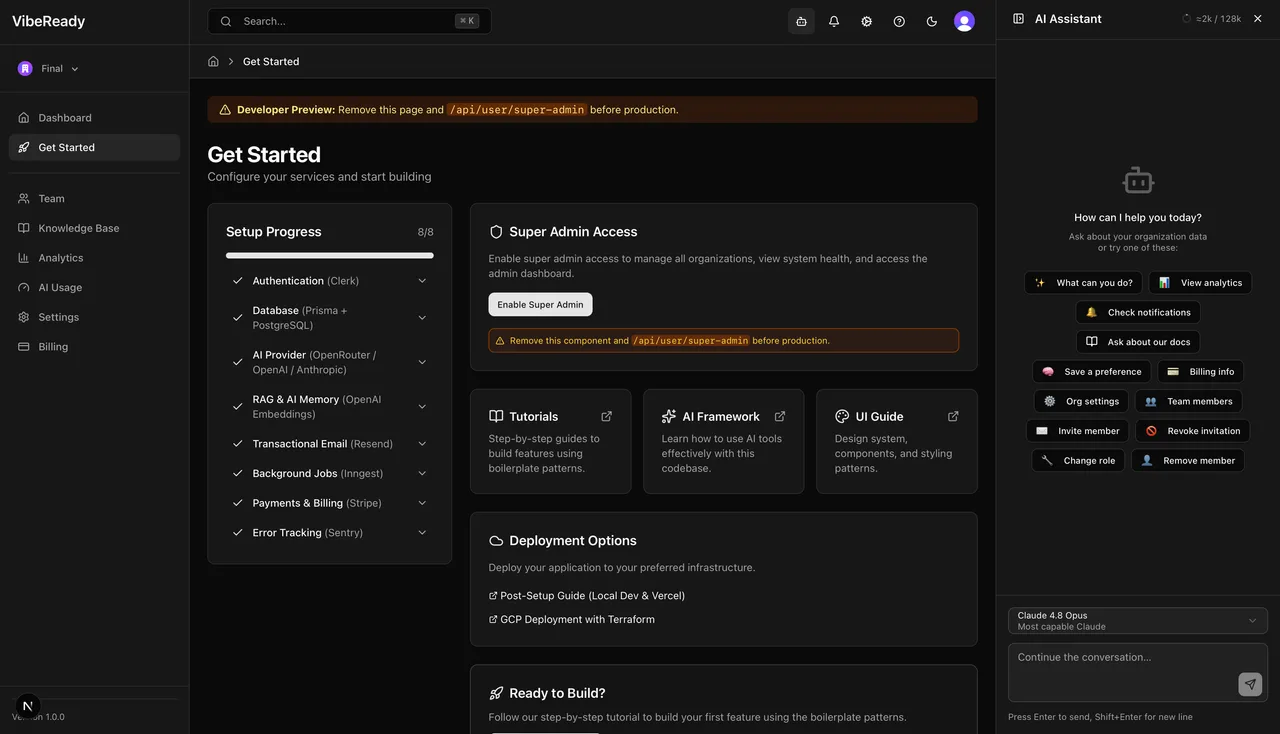
Auth, billing, multi-tenancy, RAG, background jobs, email, and error tracking. Eight services configured out of the box, not homework.
A production AI assistant that answers from your real org data and takes permissioned actions. Shipped in the kit, not a demo you build later.
Deploy to Google Cloud Run via Terraform in about 10 minutes, then vibe-code features on top of a foundation that already scales.
This is the starting line, not a prototype: the full Next.js SaaS starter kit, with auth, billing, and in-app AI already wired. You vibe-code features on top, and the AI Framework keeps every one consistent, reviewed, and tested.
Who it's for
Ship a complete SaaS without a team. The AI framework acts as your senior-engineer guardrail, so AI generates code that matches production patterns from day one.
Move fast with AI without piling up the tech debt that kills a project at feature 10. Quality gates and repeatable workflows keep momentum without the mess.
Start on production patterns so AI generates code the right way from day one. No learning architecture the hard way; it's built in.
Standardize AI workflows across the team so every developer gets consistent output: same patterns, same quality gates, same results.
Pricing
One-time payment. Unlimited projects. No subscriptions, no per-seat fees.
Best for: Existing projects — add structured vibe coding to any tech stack with PRD workflows, skills, and quality gates.
Get AI FrameworkBest for: New projects — a production-ready SaaS with agentic AI features (RAG, memory, human-in-the-loop) built in.
Get Full KitOne-time payment, lifetime updates, unlimited projects. Not sure yet? See exactly what's inside or browse the full docs before you buy.
Before you ask
Yes, but with a caveat. AI can generate features from plain-language prompts fast, yet vibe coding a full SaaS from a blank repo tends to drift into inconsistent patterns, duplicated code, and security gaps by feature 10. The reliable path is to start from a production-ready foundation (auth, billing, multi-tenancy, and infrastructure already built) and vibe-code features on top. That is what VibeReady provides: a starter kit where AI builds on proven patterns instead of inventing them.
Harden the parts AI tends to get wrong before you ship: real authentication and session handling, payment and webhook edge cases, multi-tenant data isolation with every query scoped to an organization, input validation, and a security pass for the OWASP Top 10. Then add tests, error tracking, and monitoring. VibeReady ships these as solved foundations (Clerk auth, Stripe billing, organizationId-scoped data, Sentry, plus type checks and lint on every commit and your tests in CI), so the prototype-to-production gap is mostly closed on day one.
It depends on scope. A focused MVP is realistic in days to a few weeks when the foundation is already there; building auth, billing, and infrastructure from scratch first is what adds weeks or months. With VibeReady, setup runs through the make setup wizard and you deploy to Google Cloud Run in about 10 minutes, so your time goes into features instead of plumbing.
The vibe coding workflow works with Claude Code, Cursor, Windsurf, Gemini CLI, Copilot, Aider, and any LLM that reads markdown. VibeReady's Smart Context Router is built on AGENTS.md, the LLM-agnostic standard, so you're never locked into one tool.
Some basics help, but VibeReady's structured workflows guide AI to generate production-quality code even if you're learning. The PRD-driven workflow means you describe what you want in plain language, and AI follows your project's patterns automatically.
AI builders like Lovable and Bolt are the fastest way to a first demo, and you can export the code. The wall comes at scale: patterns drift, costs climb, and you're building inside their runtime. VibeReady gives you a production codebase you own, with auth, billing, database, and infrastructure, that stays consistent as you grow.
Smart Context Router (AGENTS.md), a 23-skill library following the Agent Skills open standard, living docs that Git hooks keep in sync, quality gates (type checks and lint on every commit, tests in CI, and an AI OWASP security review), and PRD-driven development workflows.
Yes. It's a full SaaS starter kit that works as a traditional boilerplate. The AI Framework is a bonus layer: when you do use Claude, Cursor, or any AI coding tool, it automatically understands your architecture and generates consistent code.
The starter template is built on Next.js 16, TypeScript, Prisma, PostgreSQL, Tailwind CSS, and shadcn/ui. Integrations include Clerk auth, Stripe billing, Resend email, and Inngest for background jobs. Infrastructure: Terraform for GCP, Docker, and GitHub Actions CI/CD, all AI-documented out of the box.
The AI Framework starts at $149, and adds structured vibe coding to any project. The Full Kit with all SaaS features, infrastructure, and AI Framework is $399. Both are one-time payments with unlimited projects, no subscriptions, and lifetime updates.
Have more questions? See our full FAQ →
Stop fighting AI output. Start shipping features. VibeReady's structured workflows turn vibe coding from "fast but fragile" into "fast and production-ready."
Free: session-post-mortem, an Agent Skill for your AI coding tool
A drop-in skill that makes your AI coding tool remember what you taught it. Works with Claude Code, Cursor, Codex, Gemini CLI, Copilot and Windsurf. Plus occasional AI development tips.
No spam. Unsubscribe anytime.