more issues found in AI-written code than in human-written code.
CodeRabbit 2025 ↗ AI SAAS BOILERPLATE
 The AI-Native SaaS Boilerplate with a Built-In AI Framework
Most SaaS boilerplates only give you features. VibeReady adds a 3-layer AI Framework on top of a production-ready Next.js AI template, so you build the features specific to your business with AI, without worrying about architecture, patterns, or quality. An AI SaaS starter kit actually built for AI-driven development.
One-time purchase · unlimited projects
Claude Code
Cursor
Windsurf
Gemini CLI
Copilot
Updated September 2026
The AI SaaS boilerplate, by the numbers
23 AI skills & automations
21 step-by-step tutorials
20+ SaaS features built in
10 min to first deploy
The category
What Is an AI SaaS Boilerplate?
In one answer
An AI SaaS boilerplate is a pre-built codebase that combines the standard SaaS foundation (authentication, billing, teams, deployment) with working AI features: streaming chat, RAG, and multi-provider LLM routing. Instead of wiring infrastructure for months, you customize a product that already runs.
Most kits stop at the feature list. An AI-native boilerplate structures both sides: the AI features your users see, and the AI tools that build them.
shipped SaaS plumbing auth · billing · teams · jobs
shipped AI agent plumbing chat · RAG · memory · HITL
you build these Your business features the part that makes it yours
day one Your startup production-ready
Describe the feature in plain English, and our AI Framework has your AI build it production-ready on a codebase designed for exactly that.
See what building that first business feature looks like: your first feature, step by step →
The problem
Most “AI SaaS Templates” Aren’t Actually Built for AI
Even with AI writing the code, a production foundation takes weeks. Prototypes come fast; production doesn’t. And the more unguided AI code you ship, the worse the numbers get:
more duplicated code blocks as AI assistance scaled up.
GitClear 2025 ↗of AI-generated code fails OWASP security tests.
Veracode 2025 ↗The demo works; the foundation doesn’t. Until auth, tenancy, and AI plumbing are production-grade, every feature sits on sand. An AI-native boilerplate ships that foundation done, and keeps the AI that builds on it guided.
The foundation bill
What you’d wire by hand without a boilerplate
- 01 Auth, orgs, and RBAC Clerk wiring · role hierarchy · permission checks per route
- 02 Billing Stripe Checkout · customer portal · webhook edge cases
- 03 Admin & operations admin panel · impersonation · feature flags · audit logs
- 04 Analytics & monitoring usage dashboards · Web Vitals · error tracking
- 05 Agentic AI streaming chat · tool calling · AI memory · MCP server · cost tracking
- 06 RAG pipeline ingestion · chunking · pgvector · per-org isolation
- 07 Infrastructure Terraform · CI/CD · secrets · deploys
With the boilerplate day one foundation shipped & tested
Why vibe coding stalls at scale → Boilerplate vs vibe coding: the math → How the boilerplates compare →
The spectrum
What Makes a SaaS Boilerplate AI-Native
Level 1
AI-Compatible
- An OpenAI route and a chat component, marketed as "AI-ready"
- Your AI tool sees bare code: no intent, no boundaries
- Every prompt reinvents patterns from scratch
- Tenant isolation depends on the prompt, not the architecture
- Drift surfaces in code review, after the damage
Level 2
AI-Aware
- A .cursorrules or AGENTS.md file, written once
- Context goes stale the moment the code moves on
- Advice, not enforcement: no gates, no tests required
- Still no workflows: every feature is improvised
- Helps until the codebase outgrows the file
Level 3
AI-Native
- 3-layer AI Framework: context, guardrails, workflows
- A library of AI skills covering the whole dev cycle
- LLM-friendly READMEs carry the business logic
- Living docs that update with every commit
- Quality gates enforce standards
- PRD-driven workflow, not ad-hoc prompts
- Tutorials and courses on driving AI properly
The AI Framework
The 3-Layer AI Framework Architecture
Turn any AI coding tool into a senior engineer on your codebase.
- Layer 1 · Context Your AI knows what this codebase is and why.
- Layer 2 · Guardrails The right rules load per file; gates block bad code.
- Layer 3 · Workflows Skills carry a feature from spec to deploy, tests included.
- Context Router · AGENTS.md + 14 rules
Your AI actually knows your codebase
AGENTS.md core rules plus scoped rules that auto-load by what you edit: touch the Prisma schema and database rules activate. Context follows your work.
- Skills & Agents · 23 · 10
A senior engineer's playbook, built in
23 structured skills and 10 subagents on the agentskills.io open standard cover the whole cycle, PRD to deploy, instead of one-shot prompts.
- Quality Gates · pre-merge
Broken code can't ship
Every AI-built change runs TDD, type checks, lint, and security scans before it lands.
- Living Docs · on commit
Docs that never drift
Git hooks regenerate module READMEs on every commit and an agent skill fills them with business context automatically, so your AI always reads the current architecture.
- MCP tools · pre-wired
The tools your AI needs, connected
Context7 docs and Chrome DevTools MCP come configured for your AI coding tools out of the box.
- Tutorials & Courses · 21 guides
Learn to actually drive AI
Step-by-step tutorials on PRD-driven development, multi-agent workflows, and production AI patterns.
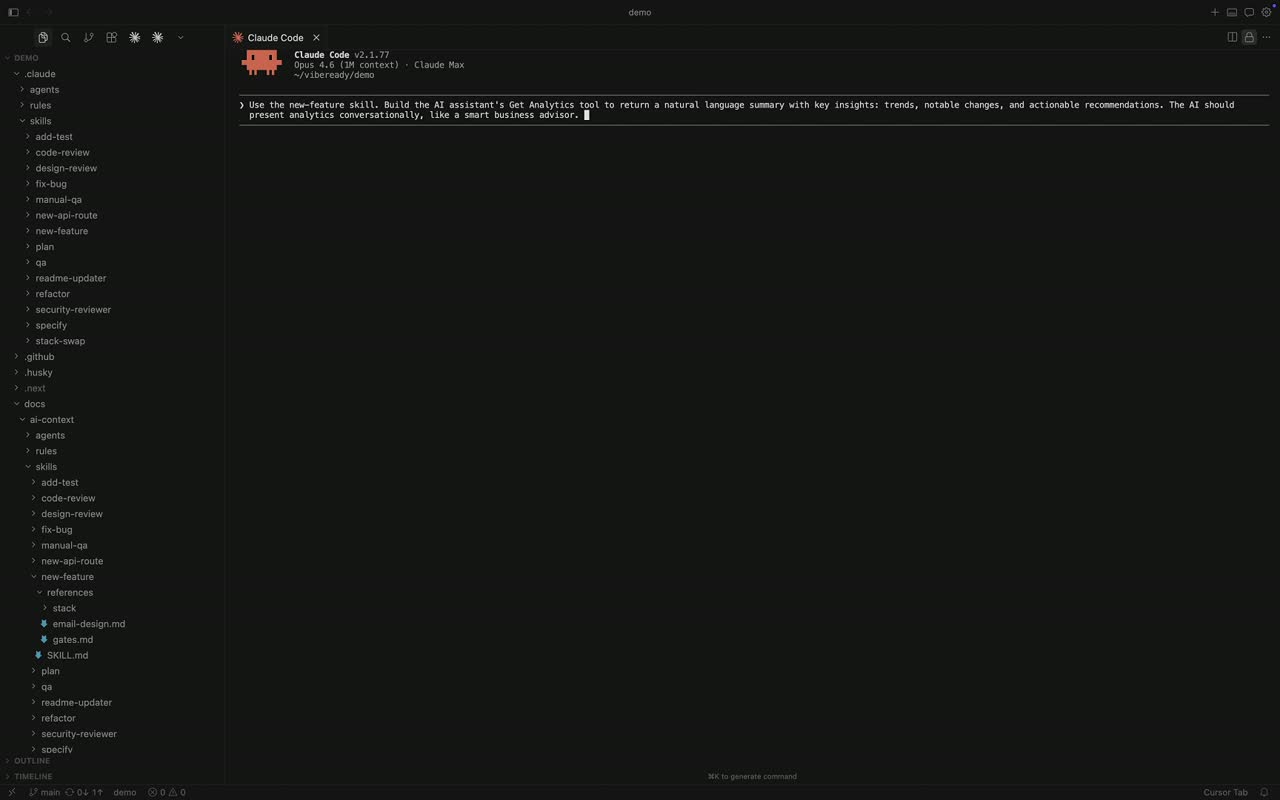
Terminalillustrative
The framework works the same in Claude Code, Cursor, Windsurf, Gemini CLI, and Copilot. See how to build a SaaS with AI, tool by tool →
AI comprehension
A Codebase Designed for AI Comprehension
Module READMEs with Business Logic
Every module has an LLM-readable README explaining what it does, why it exists, and how it connects to other modules. AI tools understand intent, not just syntax.
Consistent Architecture Patterns
Services, repositories, components — a clear hierarchy AI tools can follow. When your AI-native boilerplate has consistent patterns, AI generates code that fits, not code that fights your architecture.
Self-Extending Framework
The skill-builder and rule-builder skills let you create new skills and rules within the framework. Your Next.js AI template grows with your project — not against it.
One-Command AI Setup
Run make ai-setup and get an AGENTS.md context file, scoped rules for all tools, skill library, and MCP configs — generated and configured in seconds.
Docs That Update Themselves
Git hooks regenerate module READMEs after every change and the readme-updater skill keeps the business logic current, so AI context never drifts from the code. See how doc sync works →
Post-Mortems That Personalize Your AI
The session-post-mortem skill extracts lessons from your feedback and bug fixes, routing each to memory files, scoped rules, or AGENTS.md. Your AI gets sharper on your codebase with every session. AI memory & personalization →
Core SaaS
The Core SaaS Foundation, Built In
The plumbing every SaaS rebuilds, already wired and tested: 20+ production features with multi-tenant isolation as the default, not an upgrade.
Auth & RBAC
Clerk with MFA and magic links; 3 roles, 9 permissions, enforced server-side.
Multi-tenancy
Postgres + Prisma, every query scoped by orgId.
Billing
Stripe Checkout, customer portal, plan limits.
Dashboard
Settings, analytics, dark & light mode.
Team management
Invites, role changes, member management.
Onboarding flow
Guided multi-step setup with a get-started checklist.
Background jobs
Inngest with automatic retries; nothing blocks a request.
Transactional email
Resend + React Email templates, sent through jobs.
In-app notifications
Real-time, per-org, preferences and mark-as-read.
Super-admin portal
User impersonation (View As), audit logs.
Feature flags
Per-org overrides for gradual rollout.
Monitoring
Sentry + Web Vitals, tagged per organization.
Agentic AI
AI Features Your Users Get on Day One
VibeReady doesn’t just help you build with AI: it ships a working AI assistant your end users can interact with. Every card below is shipped code in the Full Kit, ready to customize for your product.
Streaming chat, 300+ models
Built on AI SDK v6 with tool calling and multi-provider routing via OpenRouter: 300+ models from OpenAI, Anthropic, and Google behind one API, with no vendor lock-in.
Memory and conversation history
The assistant remembers facts and preferences across separate chats, scoped per organization and user, with automatic context compaction. Threads persist with auto-generated titles, and tool calls replay when a user resumes one.
Knowledge base (RAG)
Upload PDF, DOCX, MD, or TXT and the assistant answers from your content with cited sources. Vector search runs on pgvector with strict per-org isolation.
Human-approved write-actions
The assistant can invite teammates or change roles, but every write pauses for an inline Approve / Deny step and lands in an AI-provenance audit trail.
AI usage & cost dashboard
Real per-request cost from OpenRouter, tokens, and model and tool breakdowns per user and per org, exportable to CSV. Wire it into metered billing.
MCP server
The assistant’s tools are exposed over the Model Context Protocol, so your customers’ Claude, Cursor, or scripts call your app with the same tenant scoping and role filtering as the in-app chat. Off by default, enabled per organization, every call audited.
Each of these is documented end to end — see the Knowledge Base (RAG) docs, the AI usage & cost dashboard, and the MCP server guide. This is the overview; for the full agentic breakdown (tool replay, context compaction, the HITL approval flow, and provider setup) see the AI Agent Starter Kit →
Both layers ship in one kit. Start on a foundation that’s already built.
See PricingProduction-grade
Production Infrastructure That AI Builders Skip
-
Terraform for GCP
Infrastructure as Code with Terraform modules for Google Cloud Platform. Cloud Run, Cloud SQL, Secret Manager, Cloud Storage — all defined, versioned, and reproducible.
-
CI/CD Pipeline
GitHub Actions workflows for testing, linting, security scanning, and deployment. Automated quality checks on every PR — the same gates your AI tools enforce locally.
-
Security Built In
Automated security scanning in CI, RBAC with role-based permissions, input validation, CSRF protection, and rate limiting. Production-ready SaaS template security from day one.
-
Tests as a Gate
Vitest, Playwright, and React Testing Library in a 70/20/10 pyramid with 80%+ coverage enforced; every API route ships with auth and wrong-org security tests.
These features are in the Full Kit ($399). The AI Framework ($149) works with any existing infrastructure. The whole deploy story is documented: read the GCP deployment guide →
The workflow
From Requirement to Deployment: The PRD-Driven Workflow
You don’t enforce this process by hand. The whole SDLC ships in the box: every step is a built-in skill with step-by-step tutorials, running on a foundation your AI already understands, and the quality gates make sure no step gets skipped.
-
Write a PRD
/specifyThe specify skill turns your feature description into a structured PRD: requirements, acceptance criteria, and technical constraints.
-
AI explores your architecture
plannerdb-managerSubagents read module READMEs, existing patterns, and your schema and service layer before writing a single line of code.
-
Plan breaks the PRD into tasks
/planThe plan skill decomposes the PRD into implementation tasks you review and adjust before any code generation begins.
-
Build with quality gates
/new-feature/fix-bug/refactorEvery build skill runs TDD; type checks, lint, and security scans fire at each step, so pattern drift gets caught during development, not review.
-
Ship with confidence
/deployCI/CD validates everything and pushes to Cloud Run. Your codebase stays consistent; the next feature builds on a clean foundation.
-
Docs update themselves
/readme-updaterGit hooks regenerate module READMEs and the readme-updater skill fills in the business logic, so the next feature starts from current context.
-
The AI learns your project
/session-post-mortemLessons from the session get routed to memory files, scoped rules, or AGENTS.md. Your AI gets more accurate on your codebase over time.
See vibe coding best practices → Read the PRD workflow docs →
Zero to production
Running in 5 minutes. Deployed in 10.
make setup → GCP Cloud Run · Terraform IaC · CI/CD · scales to zero
PRICING
Start Building Your AI SaaS Today
One-time payment. Unlimited projects. Works with any AI coding tool.
Which kit?
Starting fresh? The Full Kit gives you the whole production SaaS plus the agentic AI layer.
AI Framework Only
Regular price $149 $99 one-time payment $50 off until Nov 1
- One command adapts all context to your tech stack
- AI loads only the context it needs (AGENTS.md)
- Any AI tool — Claude Code, Cursor, Windsurf & more
- Agent Skills (open standard) for features, bugs & more
- Auto-generated docs that never go stale
- Tests, types & security enforced every change
- In-depth guides to maximize AI in development — valuable on their own
Best for: Existing projects — add structured vibe coding to any tech stack with PRD workflows, skills, and quality gates.
Get AI Framework Full source code, lifetime updates
Best value
Full Kit
Regular price $399 $249 one-time payment $150 off until Nov 1
- Everything in AI Framework PLUS:
- In-app AI agent — chat, tool-calling & multi-provider
- Knowledge Base (RAG) — chat with your docs on pgvector
- AI memory + safe write-actions with human approval
- AI usage dashboard — real cost, tokens & tool calls
- One-command deploy to GCP — Terraform & CI/CD
- Auth, billing & multi-tenancy — ready day one
- Email, jobs, flags, super admin & audit logs
Best for: New projects — a production-ready SaaS with agentic AI features (RAG, memory, human-in-the-loop) built in.
Get Full Kit Full source code, lifetime updates
Before you ask
AI SaaS Boilerplate FAQ
What makes VibeReady different from other AI SaaS templates?
Most AI SaaS templates bolt on a chatbot or include an OpenAI API route and call it "AI-ready." VibeReady has a 3-layer AI Framework — AGENTS.md core rules, 14 auto-loaded scoped rules, and 22 structured skills with mandatory quality gates — that gives AI coding tools architectural context, pattern enforcement, and structured workflows. It's the difference between AI generating on a blank canvas and AI building within your architecture.
What tech stack does the AI SaaS boilerplate use?
Next.js 16, TypeScript, Prisma ORM, PostgreSQL, Tailwind CSS, shadcn/ui, Clerk (auth), Stripe (payments), Resend (email), Inngest (background jobs), Terraform (infrastructure), Docker, and GitHub Actions CI/CD. A modern, production-grade Next.js AI template stack.
Which AI coding tools does VibeReady support?
All five major tools: Claude Code, Cursor, Windsurf, Gemini CLI, and GitHub Copilot. Built on AGENTS.md — the LLM-agnostic industry standard for AI coding context — so there's no vendor lock-in. Run make ai-setup to generate configs for all tools at once.
What is AGENTS.md and why does it matter?
AGENTS.md is the industry standard for giving AI coding tools your project's rules, architecture, and conventions. VibeReady builds on it with 14 scoped rules that auto-load based on what files you edit, plus 22 structured skills that enforce quality gates — making it a complete AGENTS.md starter kit for any AI SaaS starter kit project.
Can I use VibeReady without AI tools?
Yes. VibeReady is a full SaaS starter kit with 20+ production features — auth, payments, multi-tenancy, RBAC, background jobs, email, admin dashboard, and more. The AI Framework is a bonus layer that activates when you use AI coding tools.
How does the AI Framework work across projects?
Run make ai-setup and the framework generates all configuration files — AGENTS.md, scoped rules for each tool, skill library, and MCP configs. It adapts to your project structure. One-time purchase, unlimited projects.
Can I use it with an existing project or a different tech stack?
Yes. The AI Framework ($149) installs into an existing codebase: make ai-setup generates AGENTS.md, scoped rules, and the skill library adapted to your project structure. If your stack differs from the kit's defaults, the built-in stack-swap skill walks your AI tool through adjusting the framework to your technology — rule files, skill references, and the stack manifest get updated (say, Drizzle instead of Prisma or NextAuth instead of Clerk) while the universal principles stay intact.
Is this production-ready or just a prototype starter?
Production-ready. The Full Kit ($399) includes Terraform Infrastructure as Code for GCP, CI/CD pipeline with GitHub Actions, automated security scanning, RBAC with role-based permissions, multi-tenancy, and a super admin dashboard. It's a production-ready SaaS template, not a weekend prototype.
What is PRD-driven development?
Every feature starts from a Product Requirements Document — not an improvised prompt. Run specify to create a structured PRD from templates, plan to break it into implementation tasks, then new-feature to build with TDD and quality gates. It replaces ad-hoc prompting with a repeatable, auditable workflow.
Does VibeReady include an AI assistant for end users?
Yes. The Full Kit includes a working AI assistant built on AI SDK v6 with multi-provider LLM support (OpenAI, Anthropic, Google via OpenRouter). It goes well past launch-era tool calling: persistent conversation memory (sidebar history, auto-titles, resume, tool replay) plus cross-session memory scoped per org and user, a Knowledge Base / RAG layer on pgvector so it answers from your uploaded docs, and human-in-the-loop approval on write-actions like invites and role changes — with an AI-provenance audit trail. Since v1.0.0 the same tools are exposed over MCP, so your customers can drive the app from Claude, Cursor, or a script. You customize the system prompt, tools, and UI for your product's specific use case.
Which LLM providers does the built-in AI assistant support?
Out of the box, VibeReady connects to OpenRouter, giving you access to 300+ models from OpenAI, Anthropic, and Google through a single API. You can also connect directly to OpenAI, Anthropic, or Google APIs. Switching providers is a config change (LLM_PROVIDER plus the provider's API key) with no code changes.
Have more questions? See our full FAQ →
Ready to Build AI-Native SaaS?
Stop building on boilerplates that don’t understand AI. Start with a foundation that makes AI coding tools productive from day one.
Free: session-post-mortem, an Agent Skill for your AI coding tool
A drop-in skill that makes your AI coding tool remember what you taught it. Works with Claude Code, Cursor, Codex, Gemini CLI, Copilot and Windsurf. Plus occasional AI development tips.
No spam. Unsubscribe anytime.